Onect AI
/
AI-native legal-tech platform + SAAS
The O-1 visa process breaks down on both ends.
Applicants have no clear roadmap to prove their extraordinary ability, and attorneys are buried in manual document review, where errors are inevitable. Nearly 30% of petitions get flagged as a result.
Onect bridges that gap, giving professionals the structure to build a compelling case and attorneys the clarity to review one.
My Role
Product designer, AI workflow architecture
Timeline
August 2025 – March 2026 (8 months)
Team
Skills
Design system
User research
UX/UI
※ What is O-1 visa?
The O-1 is a US work visa for individuals with extraordinary ability, requiring 100+ pages of evidence and up to a year of preparation before a decision is even made.


Achievement
UX Design Awards 2026 | Nominated
Reduced average document filing time by 70%, bringing it down from 1m 28s to just 26s.
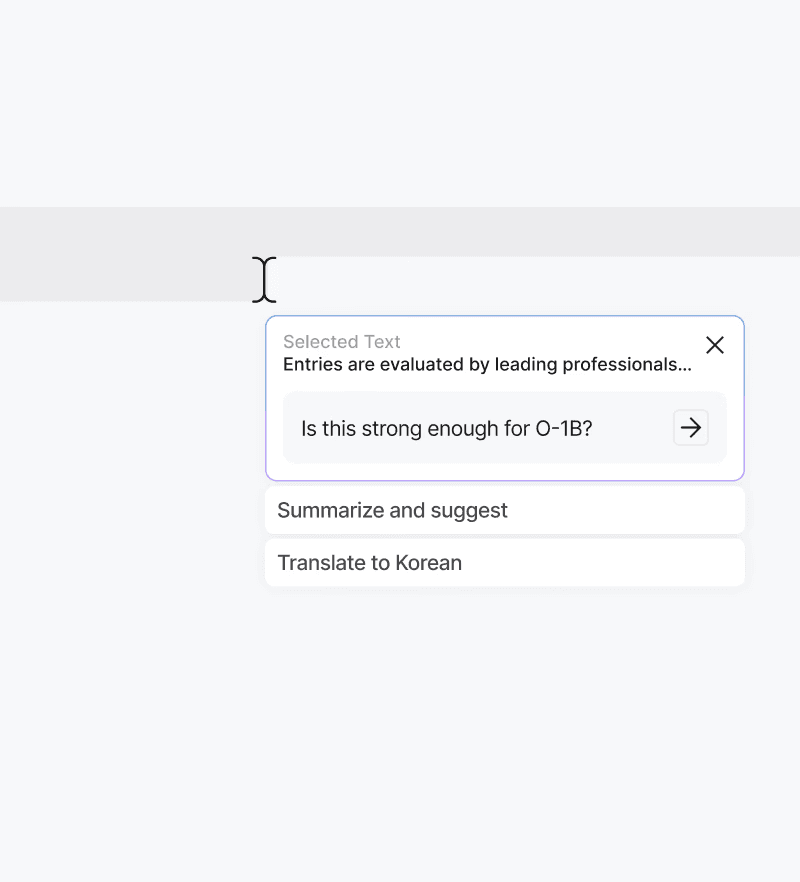
Improved client-side comprehension of legal documents by 80% through the implementation of an AI cursor interface.
My contribution
User interview
Facilitated 3 interview sessions with lawyers and created affinity maps
Design system
Built a consistent design system that applies across the platform
Interface design
Designed pages for AI cursor, AI feedback, eligibility tests and results, profile
00 — Project Origin
Where the problem became personal
The anxiety international colleagues carried through the O-1 process had little to do with qualifications. It came from the experience itself: no feedback, no structure, and no clear way to know whether the evidence they had assembled told a convincing story.
This wasn't a legal problem. It was a design problem. Nobody had built something that served both the applicant trying to understand their own case and the attorney trying to evaluate it efficiently.
Design Challenge
How might we redesign the O-1 visa experience so that applicants feel confident and in control, while helping attorneys focus on what they do best, without disrupting the workflows they already rely on?
01 — Problem
"Everyone said hire a lawyer and you'll figure it out, but that wasn't true."
Problem:
Two user types.
Completely opposing needs.
User 1: Applicant
Applicants are left feeling powerless by a lack of communication from their lawyers and deeply frustrated by an inability to track their own progress.
User 2: Attorney
On the attorney side, the problem is inverse: too many clients, too little structure. Attorneys spend the majority of their intake time reviewing documents that don't meet threshold, documents that an earlier filter could have caught.

Why this matters beyond the users
When the visa process is too overwhelming, talented people give up before they even try. Onect doesn't just help individuals file a visa. It keeps exceptional people moving toward the places where they can do their best work.
02 — Goals & Constraints
Goals and real-world limits
Product Goals
Constraints We Designed Around
Legal sensitivity: The product cannot give legal advice. Every AI-generated output needed to be clearly framed as guidance, not counsel
Low willingness to switch: Attorneys already have document workflows. Any tool that required a full behavioral change would face immediate rejection
03 — Research & Insights
7 conversations.
One clear direction
Method
SME Interviews (n=7)
Empathy Mapping
Affinity Mapping
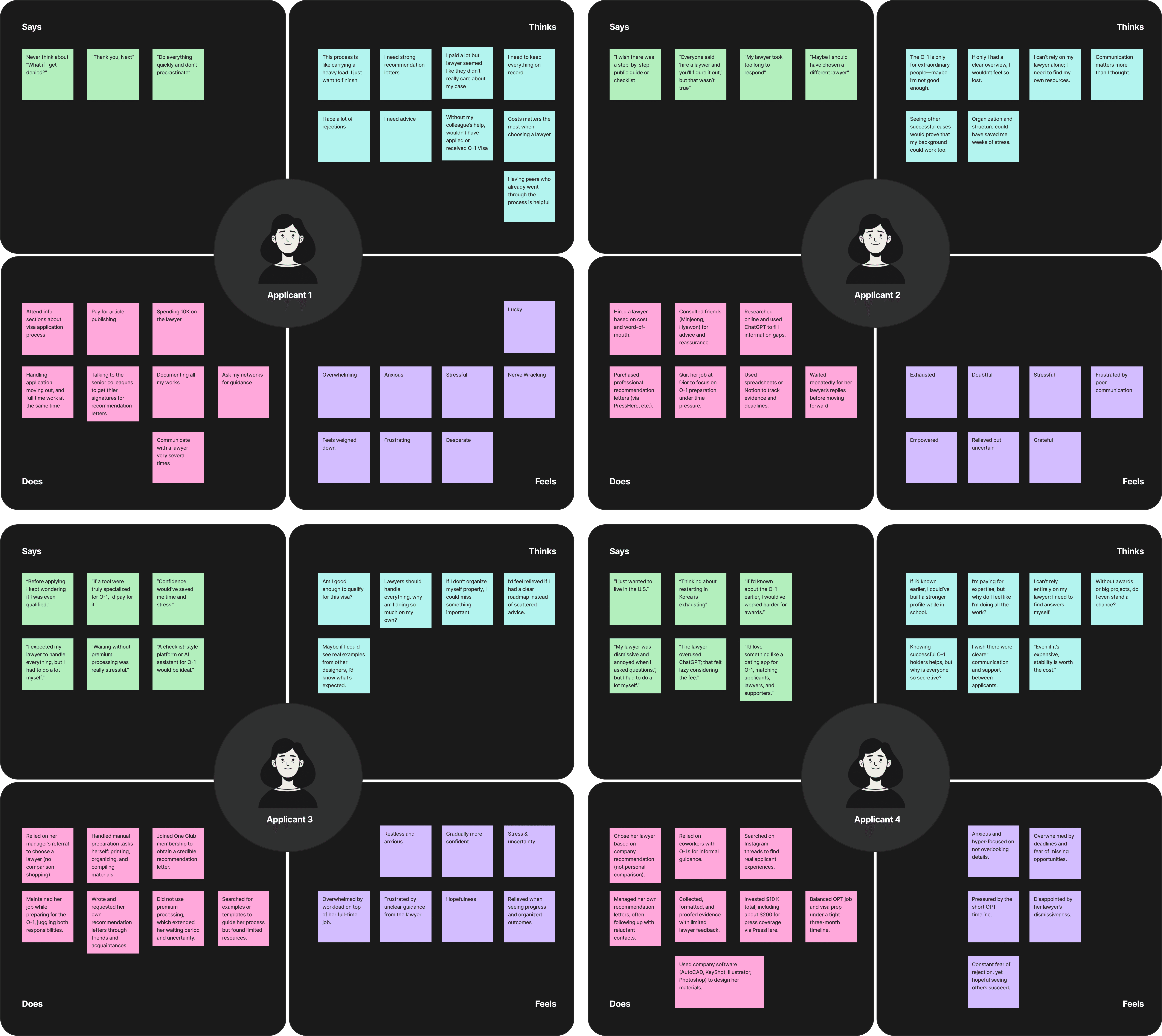
We spoke with 4 applicants who had recently received their O-1 visa and 3 immigration attorneys specializing in O-1 cases. Findings were synthesized via empathy mapping, then reframed using Jobs-to-be-Done to separate surface complaints from root causes.
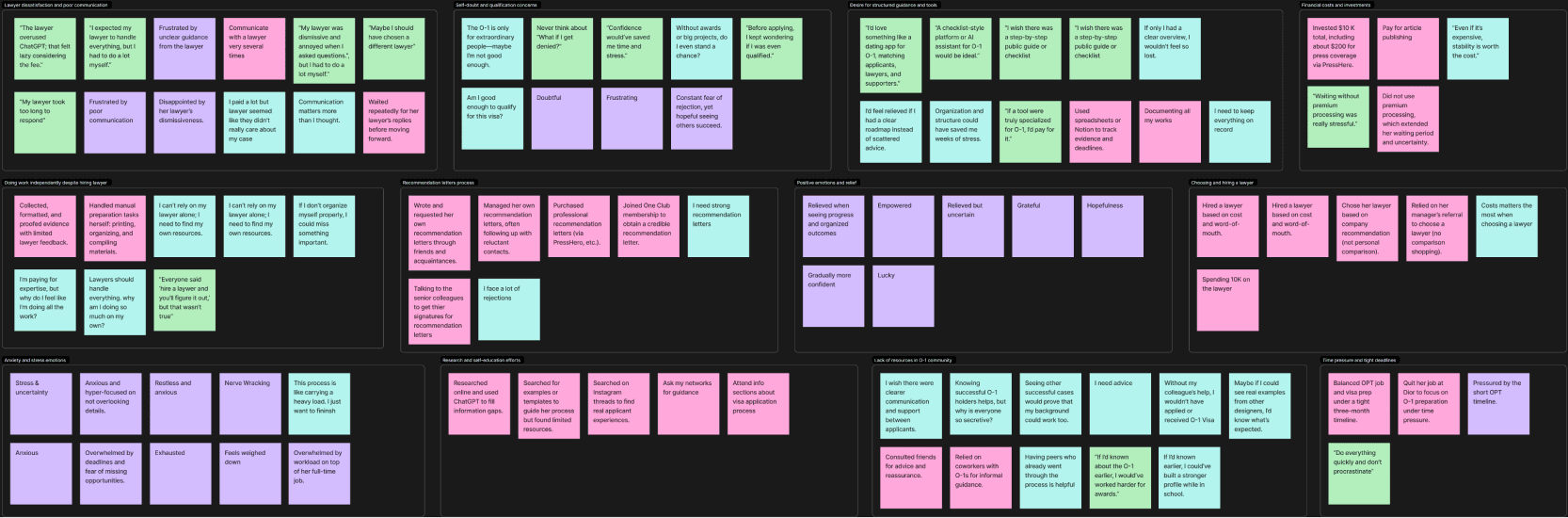
Key Jobs-to-be-Done
"Organization and structure could've saved me from weeks of stress."
- Applicant B
“My lawyer was dismissive and annoyed when I asked questions.”, but I had to do a lot myself.”
- Applicant C
"A trustworthy platform must pre-qualify applicants accurately."
- Attorney A
"We focus heavily on preventing RFEs(Request for Evidence) by having the highest quality of work."
- Attorney A
The process is discretionary against the very people it serves
Method
Competitor Analysis
N=7 was a small sample by research standards. So, we triangulated findings against public USCIS adjudication data and supplemented with a competitor audit of 8 existing tools to increase confidence in the patterns identified.
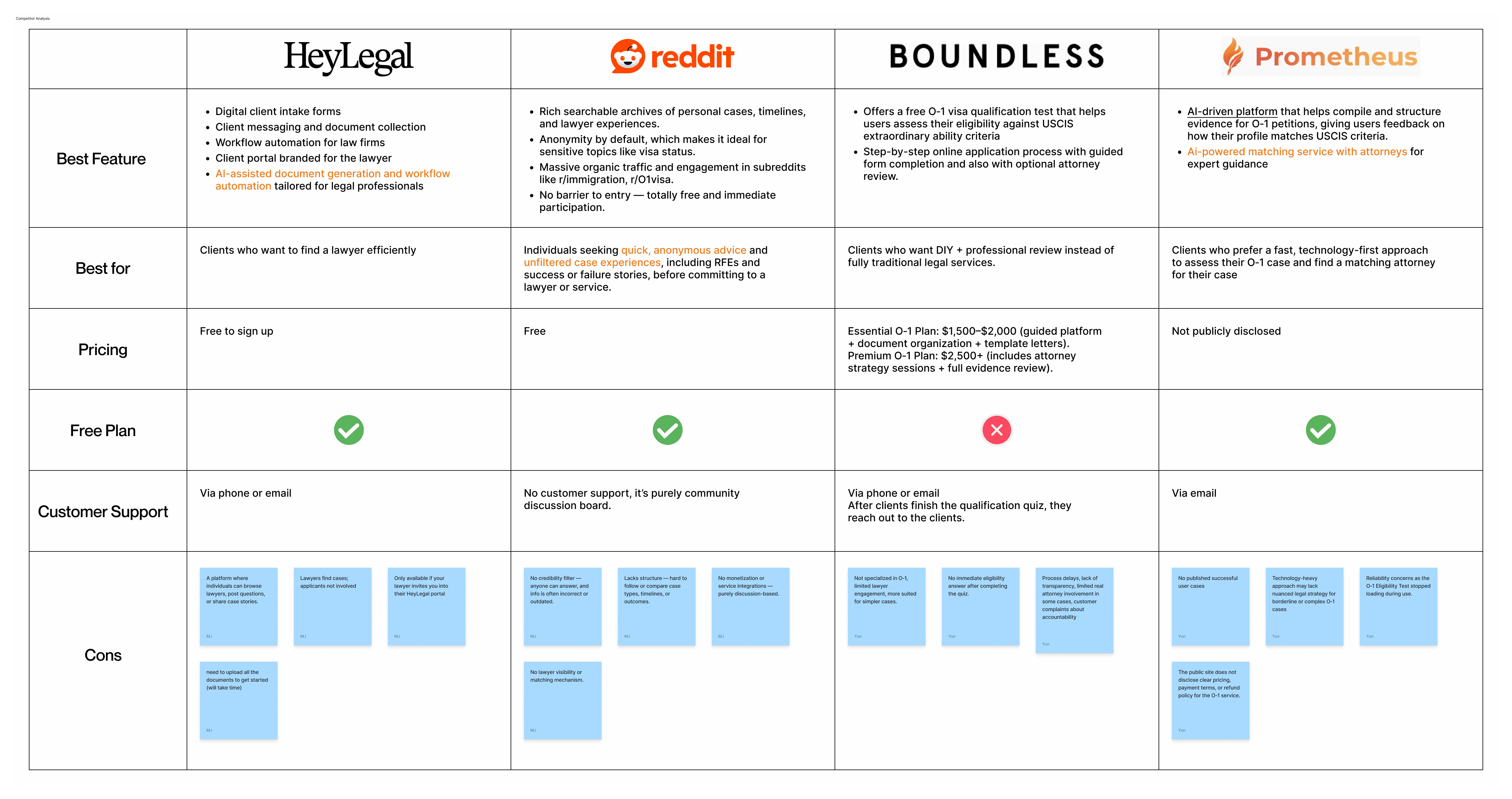
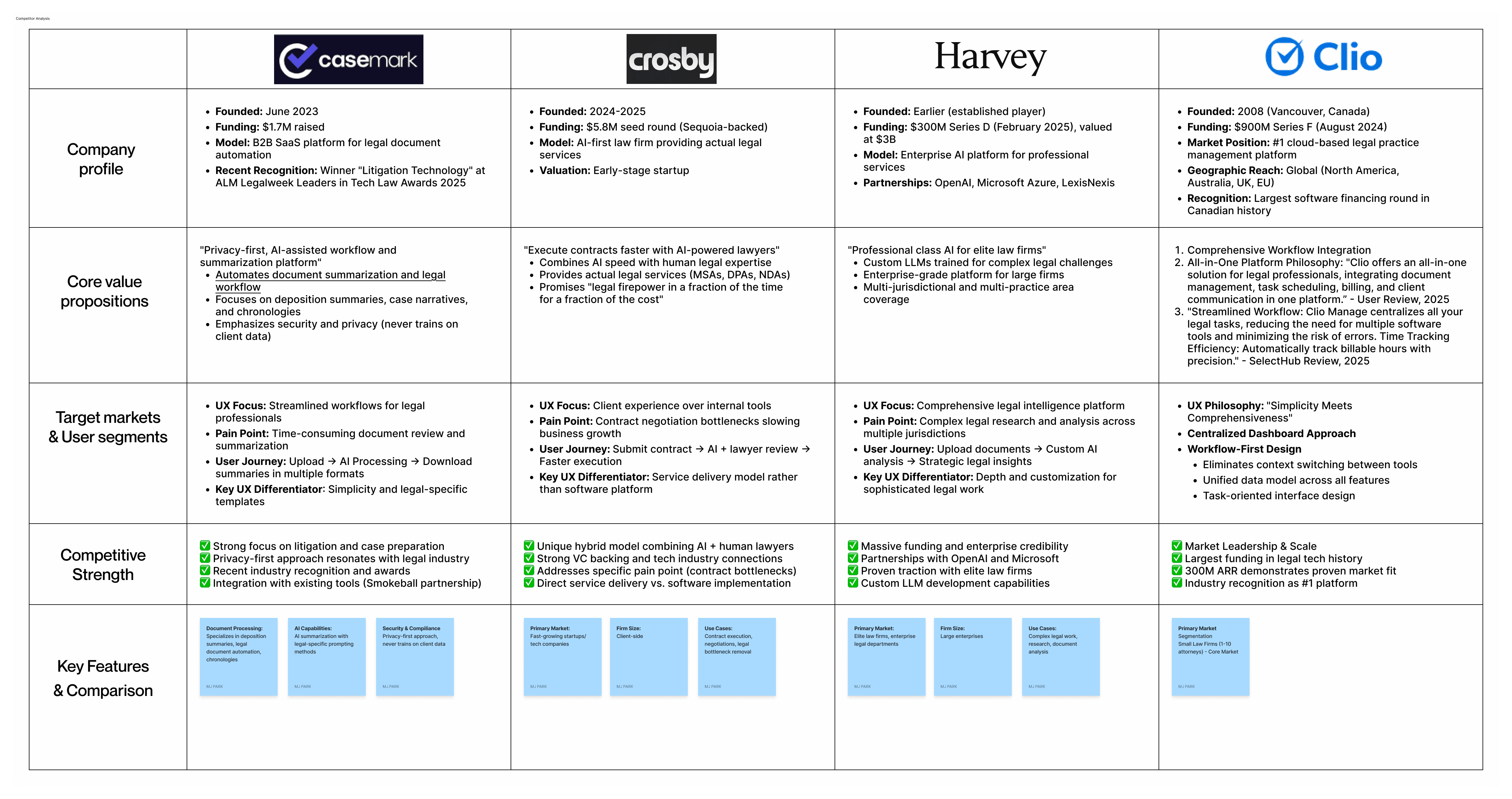
Existing tools (immigration SaaS, attorney portals, USCIS guides) shared a common failure: they were built around the process, not the person. None offered a dual-sided experience. Most existing immigration tools either served attorneys only or treated applicants as passive document suppliers.
04 — Ideation & Direction
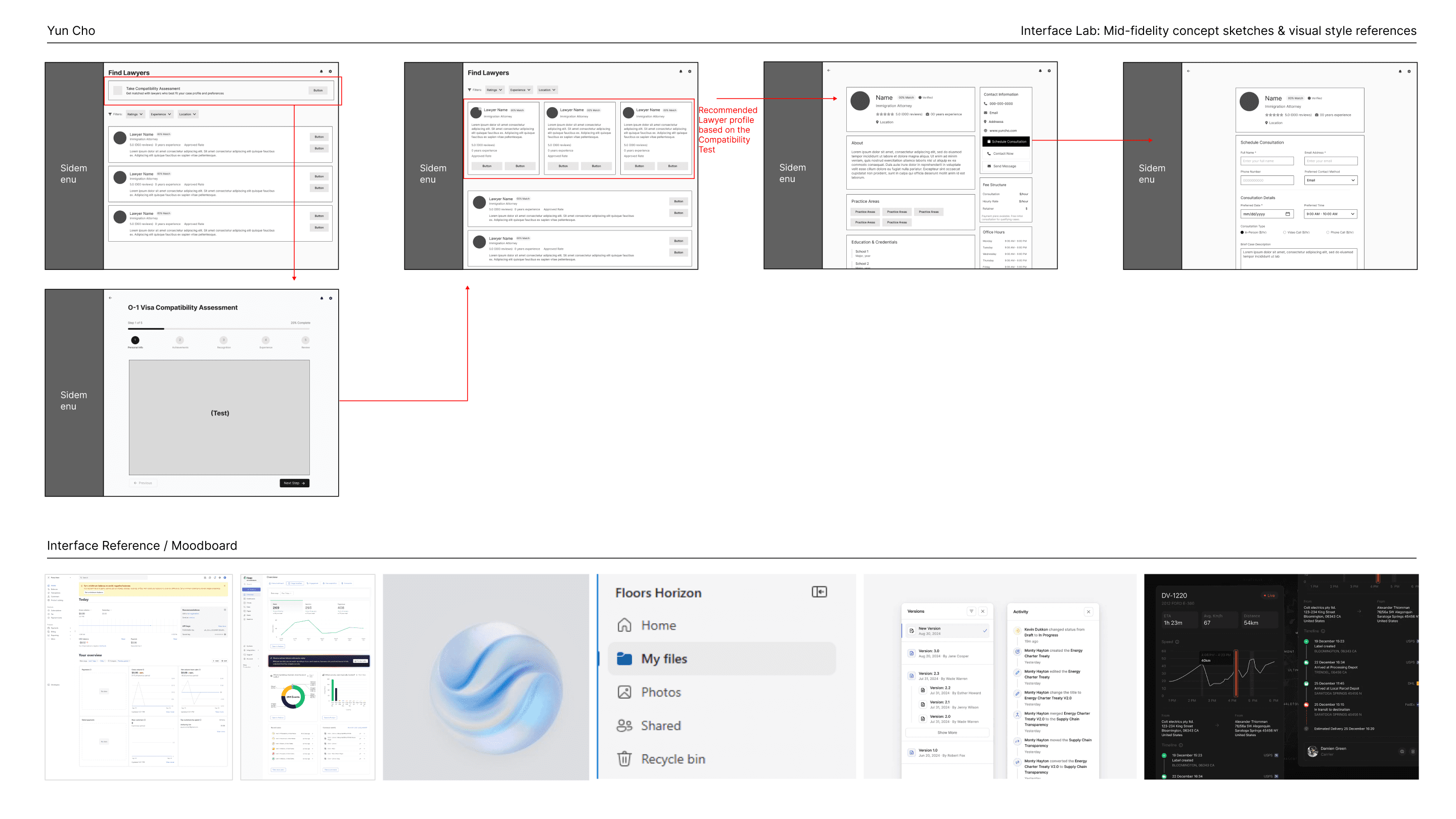
Designing for two users who want completely different things
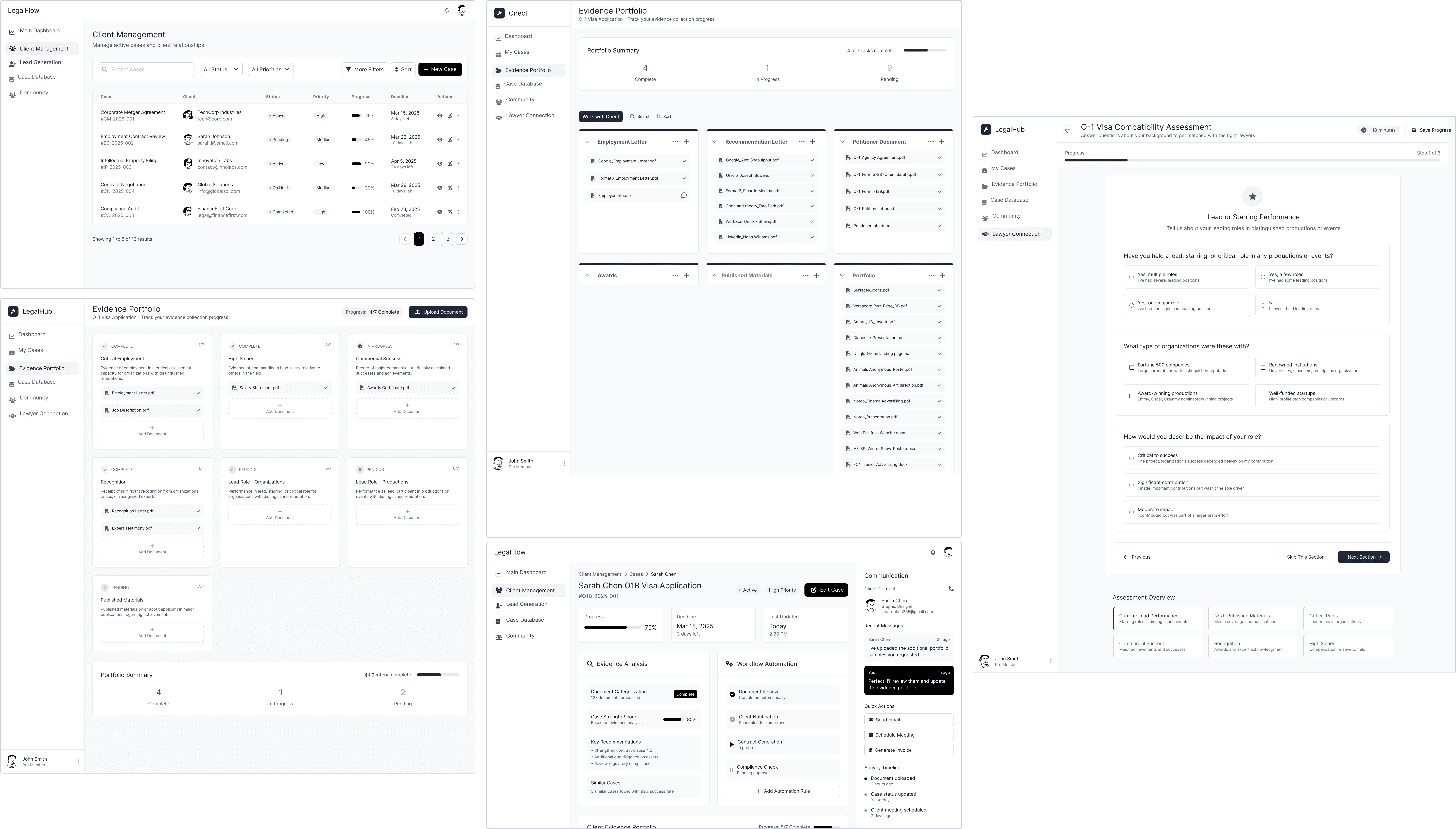
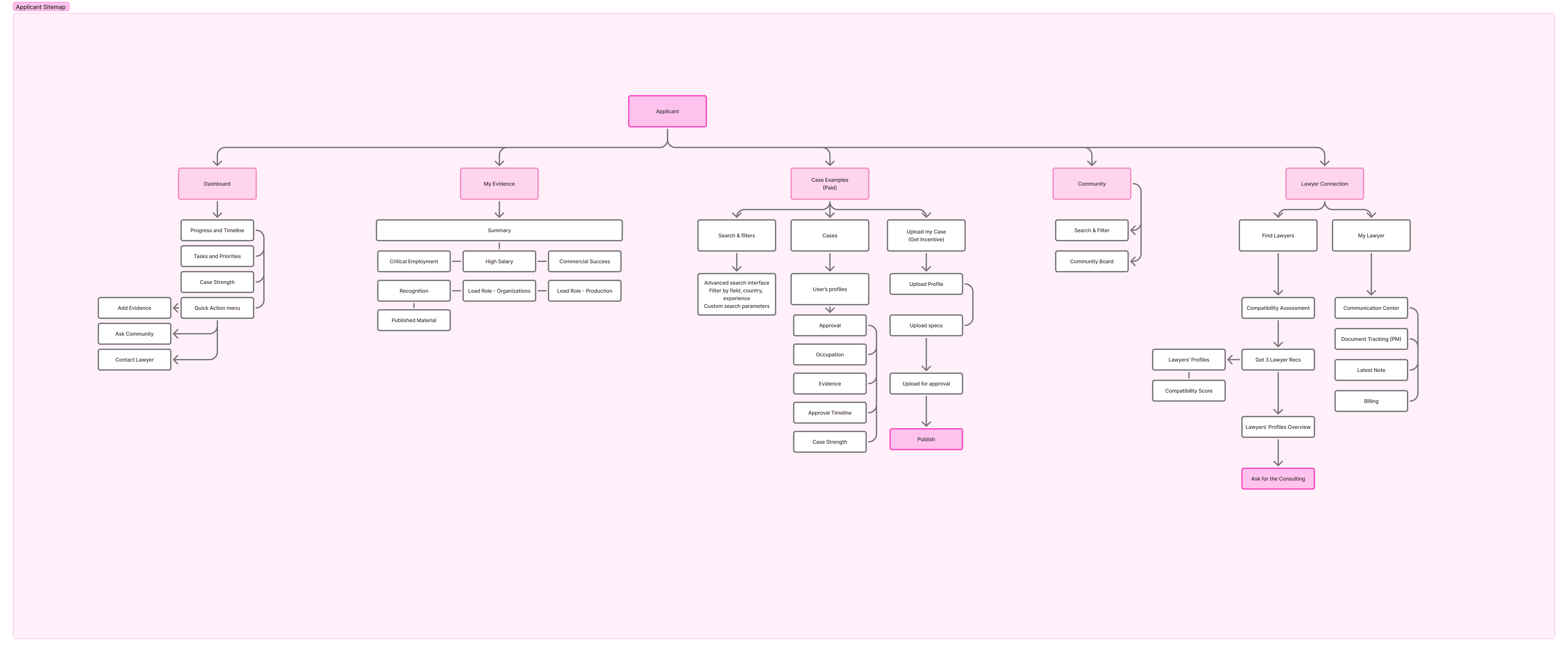
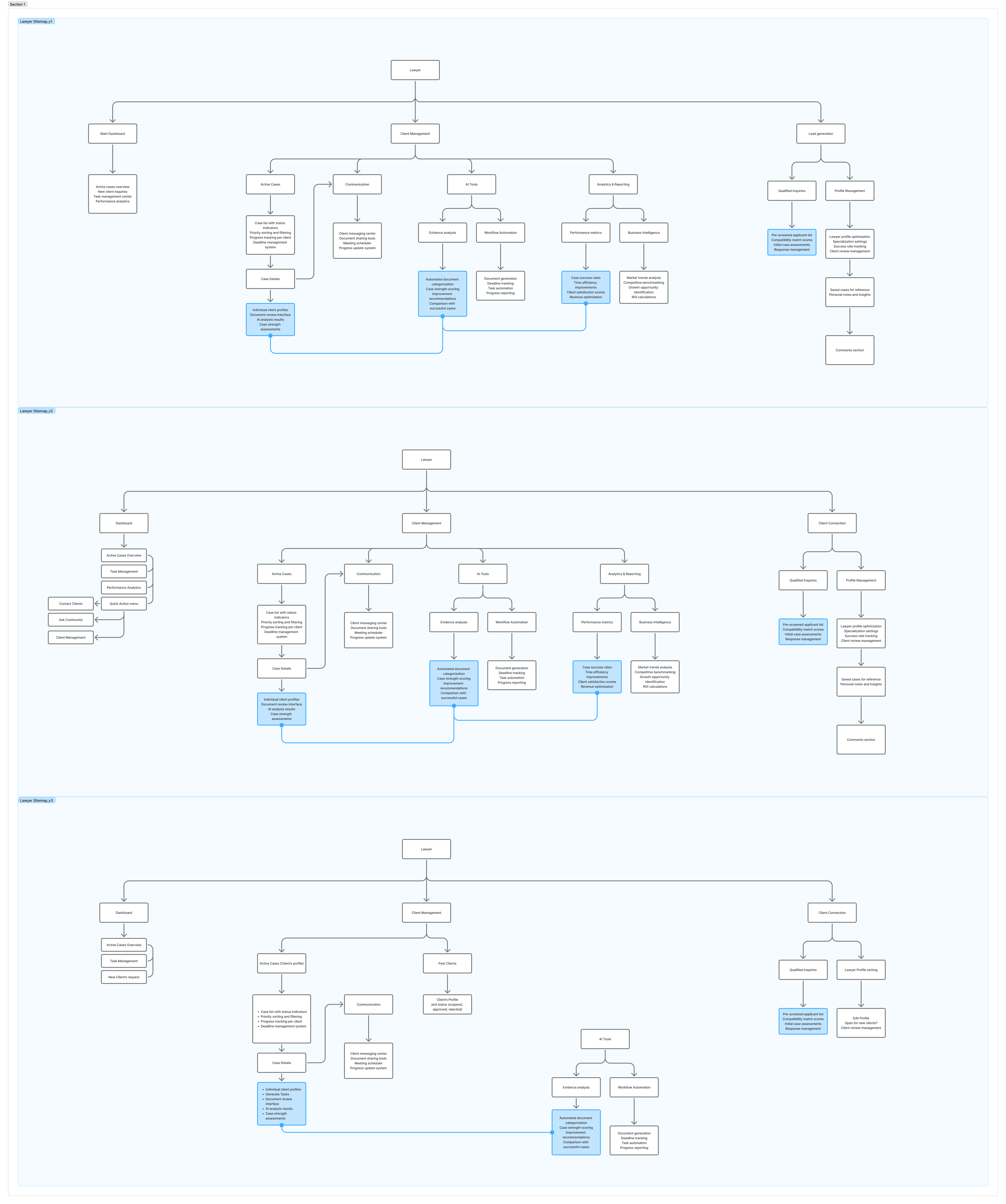
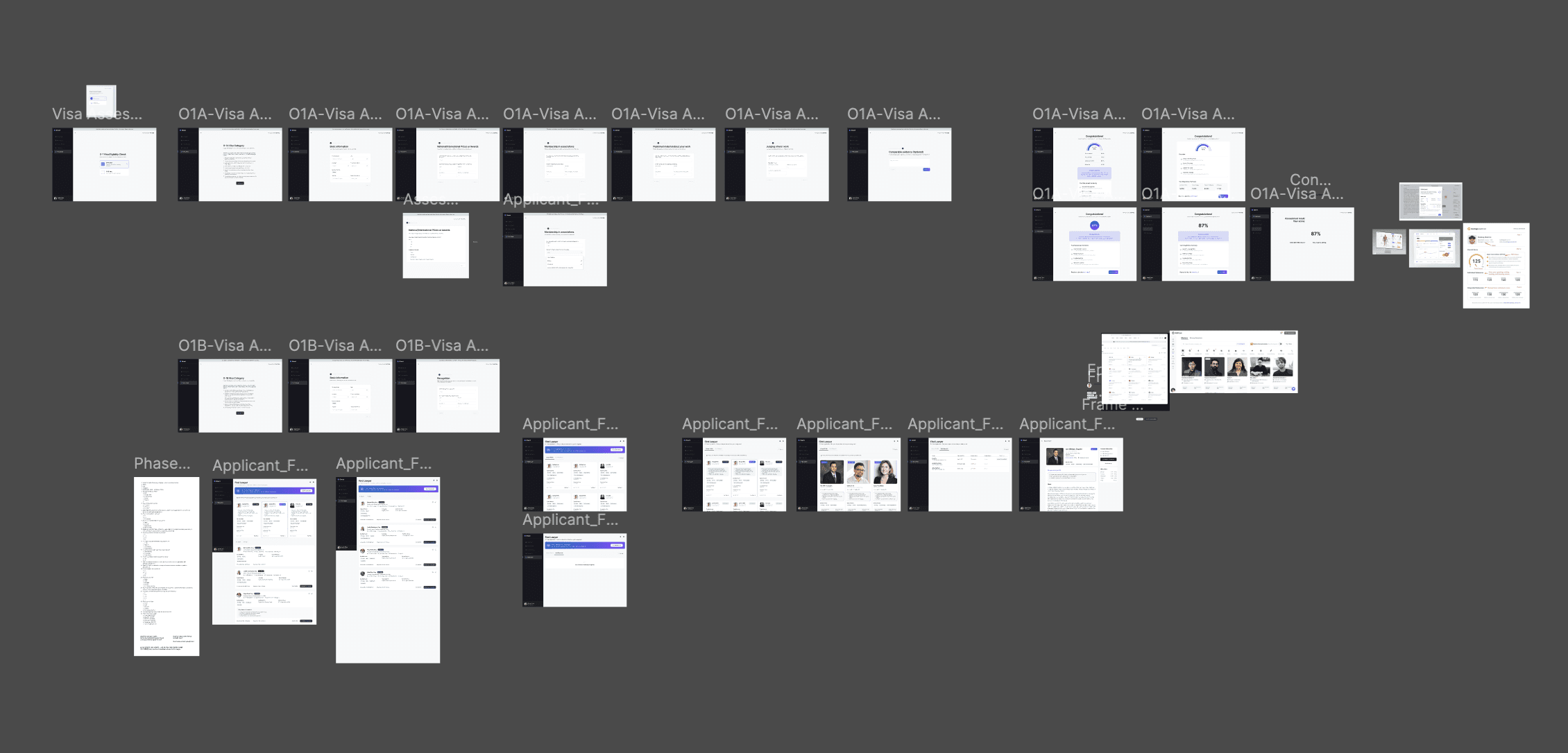
With two users pulling in opposite directions, our first ideation challenge was structural: should this be one product with dual views, or two separate products sharing a back-end?
The wrong answer here would create either a product that felt incoherent to both users, or two products that couldn't deliver the network value of a shared data layer.
Design Principle Established Here
We could have automated more. But in legal processes, one wrong assumption can derail someone's entire case. So every AI action required a human to sign off, not because technology is unfeasible, but because trust isn't something you can automate.
05 — Solution
Solution:
A system that serves two users without compromising either
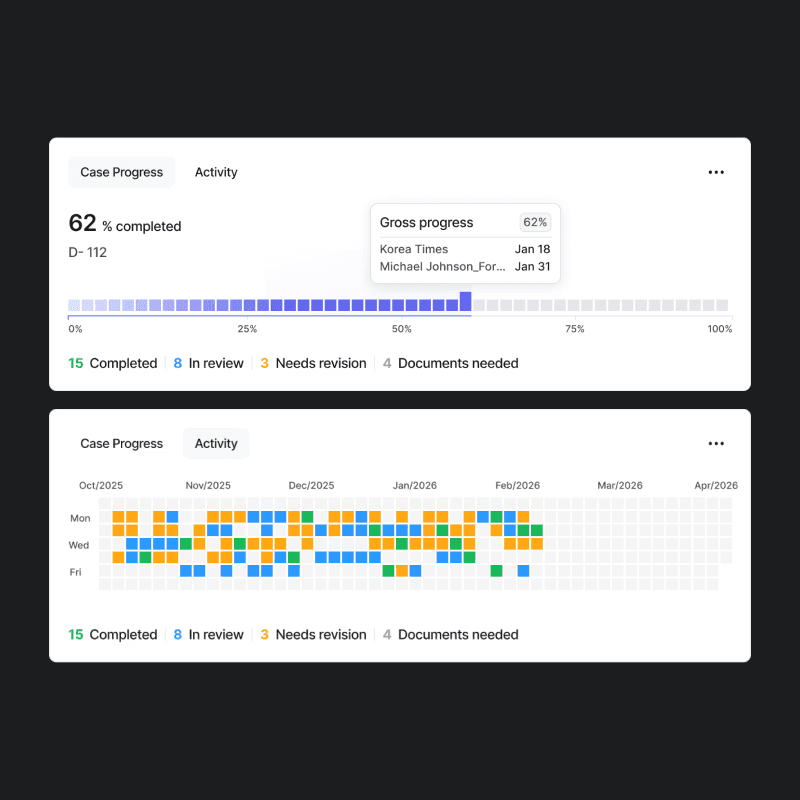
Onect AI is a role-based platform where applicants and attorneys share a data layer but never share a view. The applicant experience is built around clarity and momentum. The attorney experience is built around efficiency without disruption.

Eligibility Check + Smart Matching
Applicants begin with an eligibility test, immediately understanding where they stand for the first time
AI Document Assistant
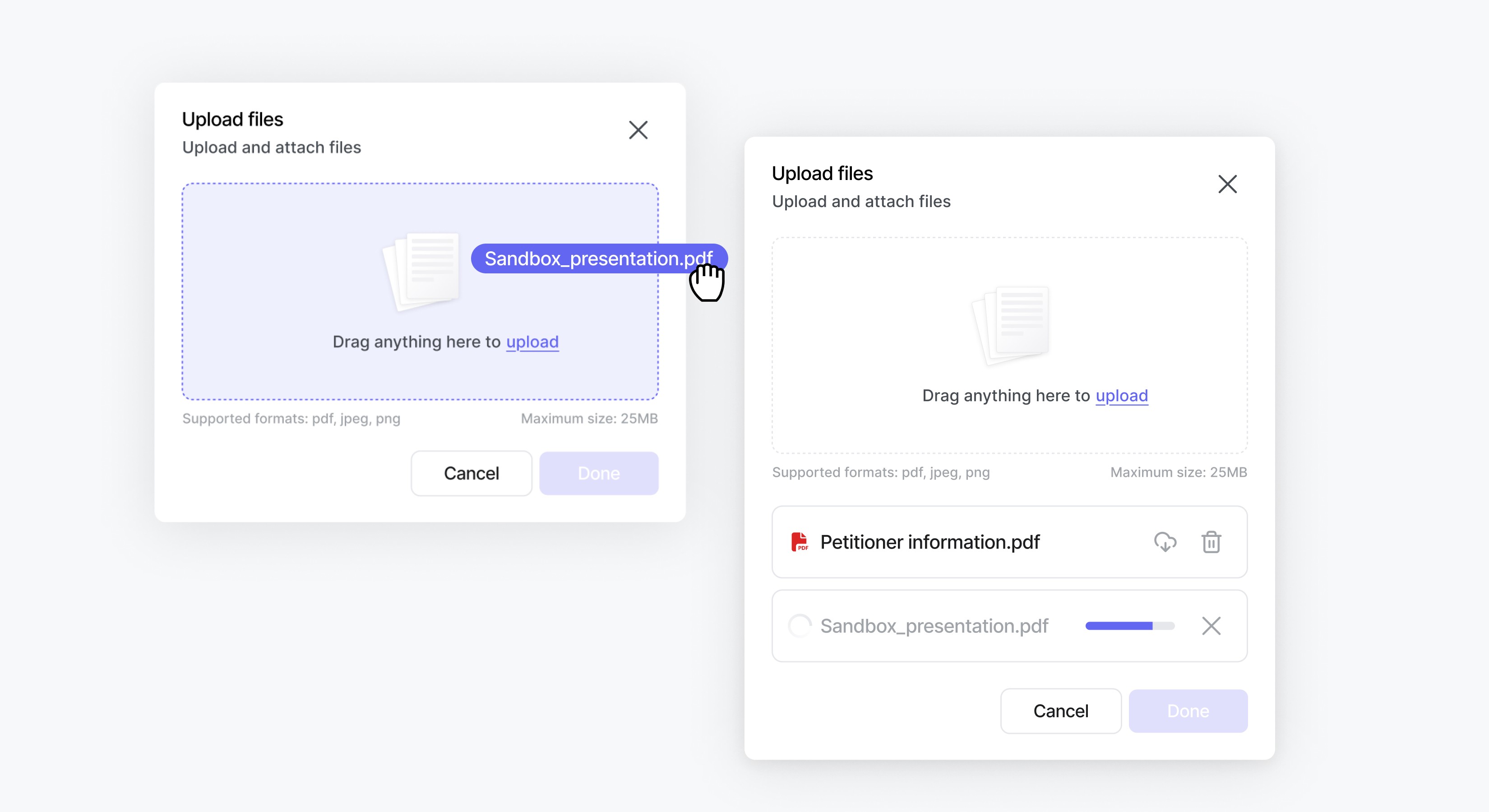
This was the research-backed decision to replace traditional legal gatekeeping with affordable, instant clarity.
Intelligent Document Classification
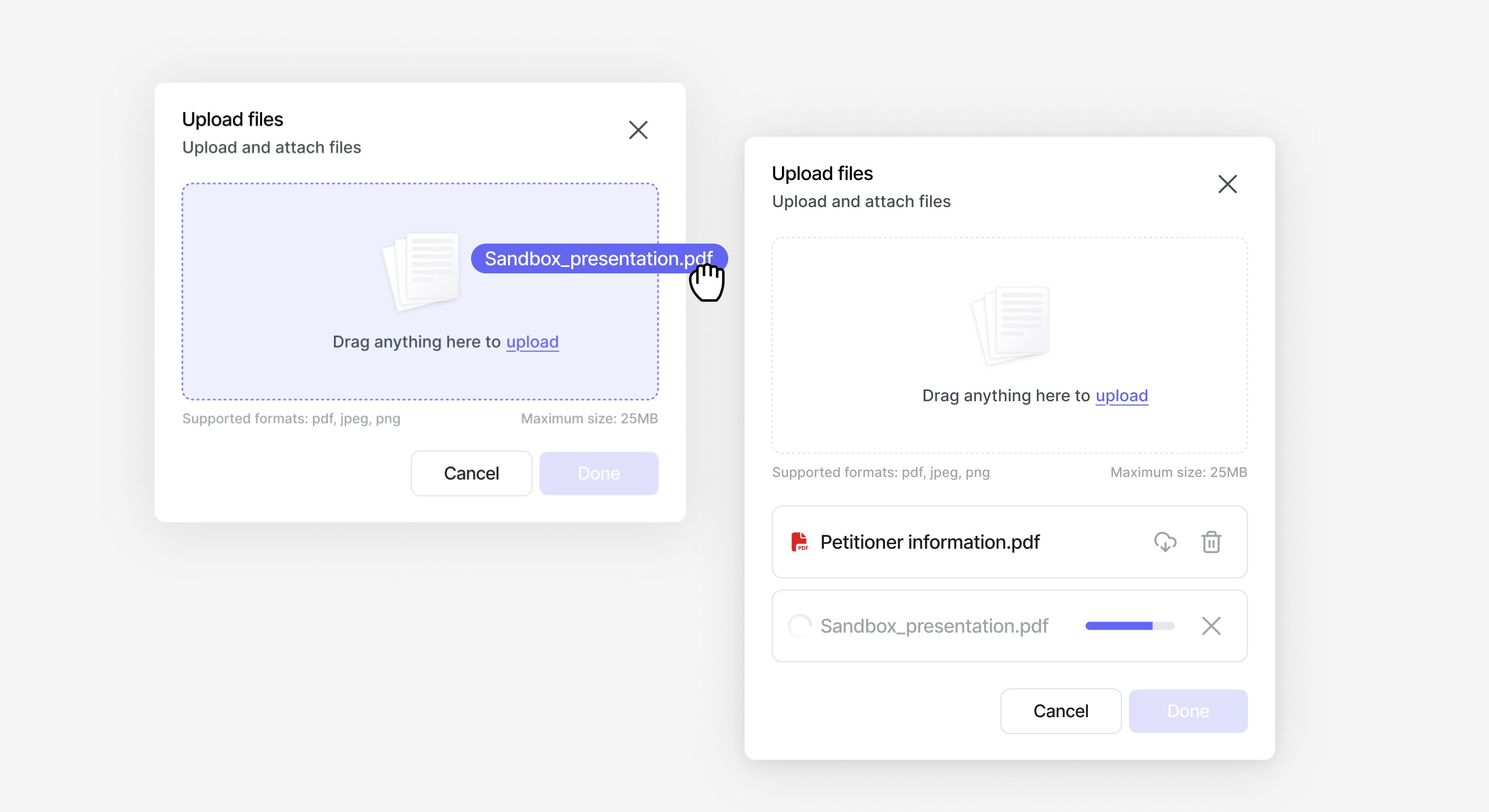
This single feature addresses the root cause of the 100+ page review problem: not the volume, but the absence of any intelligent pre-sort.
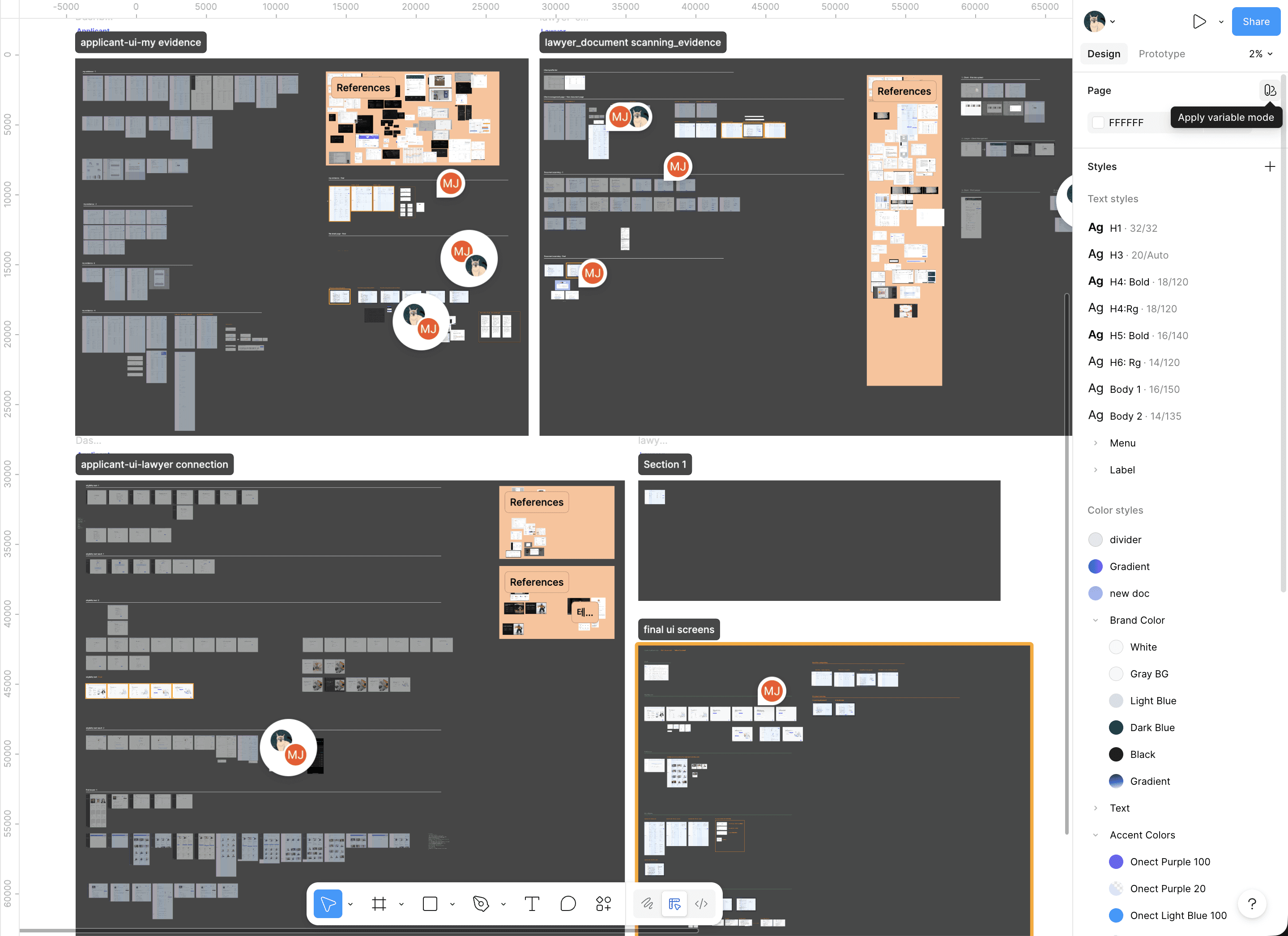
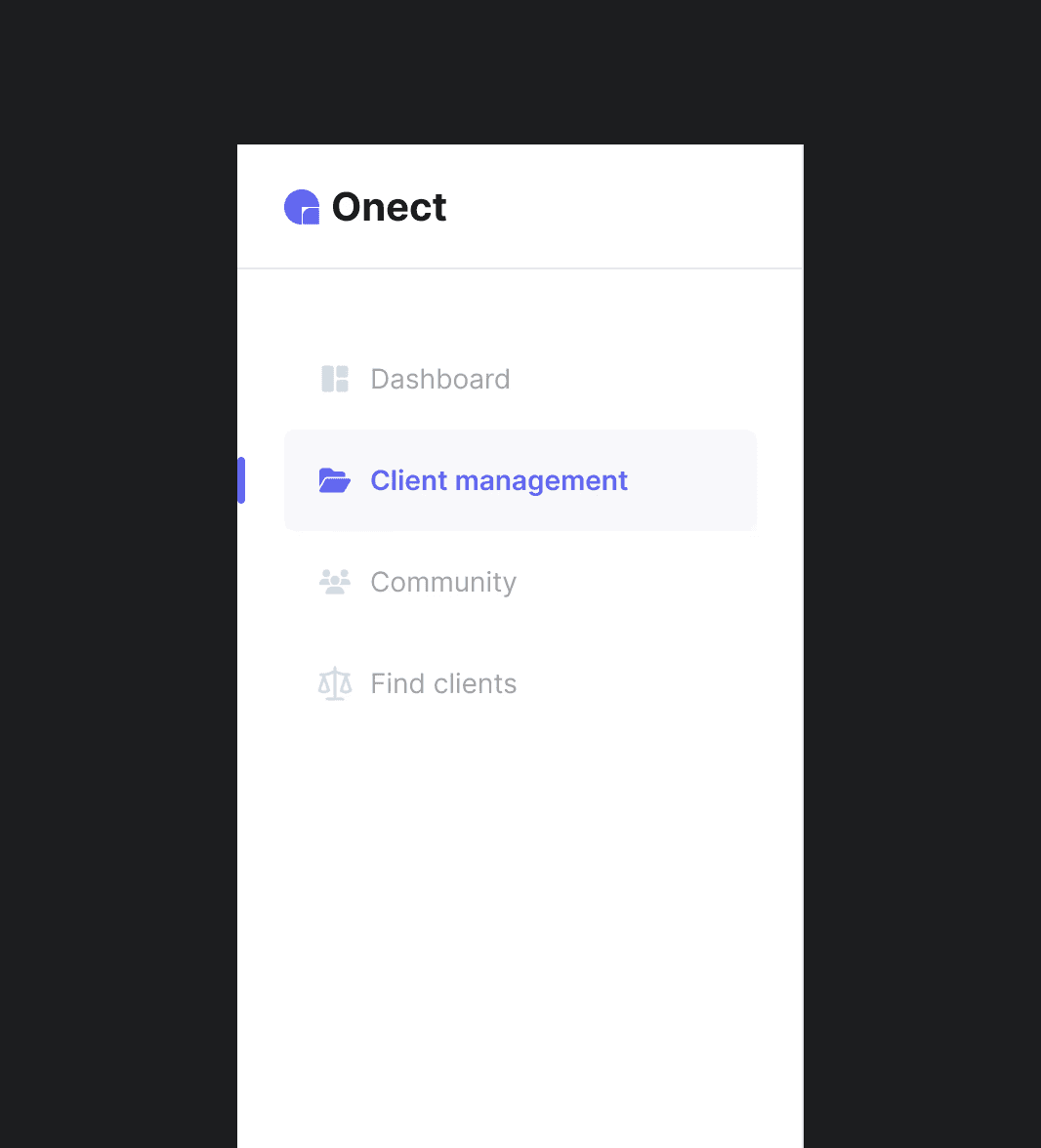
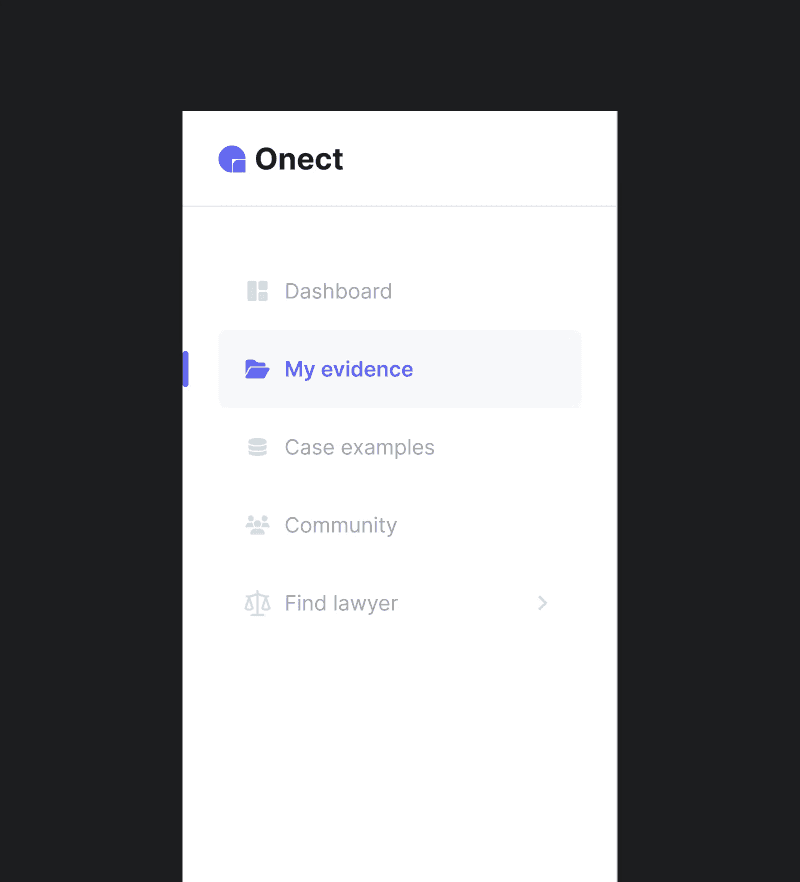
06 — Design system
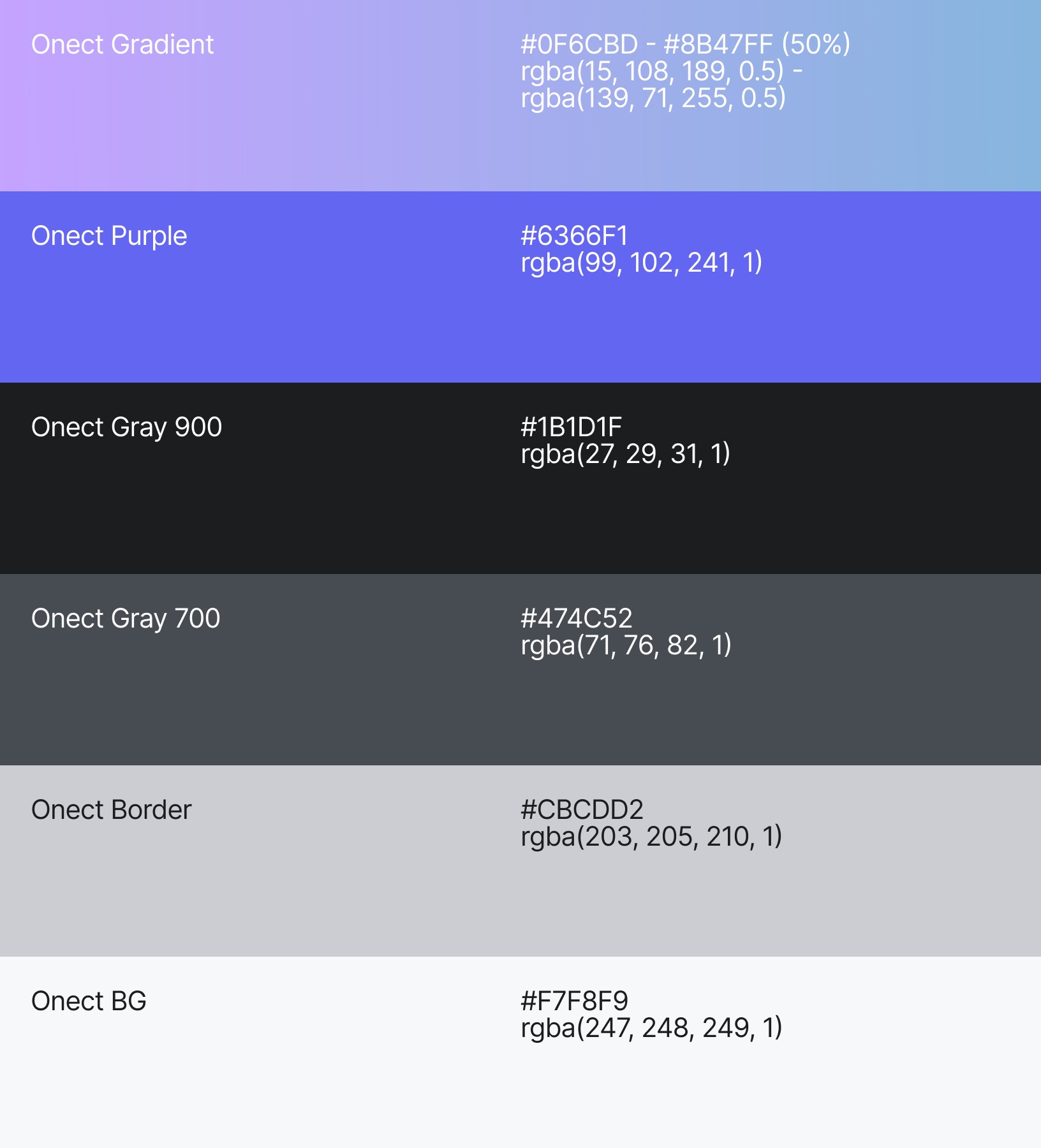
Building credibility through restraint
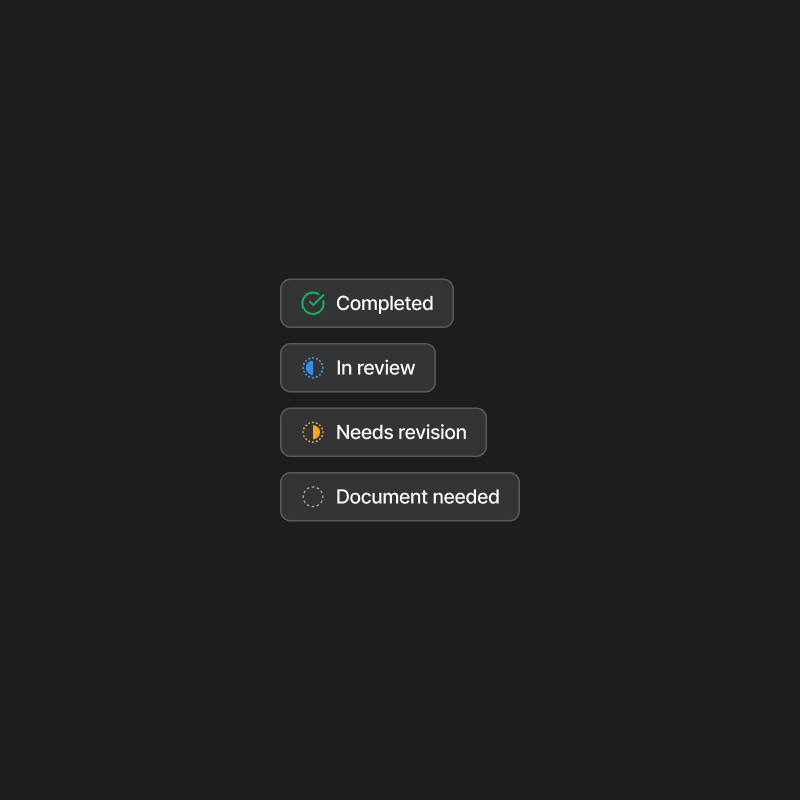
The visual language of Onect AI needed to communicate two things simultaneously: intelligence (this is a sophisticated AI system) and trustworthiness (this is handling your most sensitive documents).

Reflection
What I learned and
what I'd do differently
Designing for trust is a distinct skill from designing for usability. In high-stakes contexts, a confusing UI that feels safe will outperform a slick UI that feels opaque. Transparency in AI reasoning wasn't a nice-to-have.
The next phase of this work involves end-to-end PII encryption architecture, a financial model that doesn't require applicants to pay attorney rates for AI-assisted guidance, and a data layer that gets more accurate as more petitions flow through it.